

Reputation doesn’t collapse in a single dramatic moment. It erodes in silence, one unanswered message at a time, one forgotten defect at a time, until a buyer who once defended your brand to their friends starts warning them away from it instead. This is the quiet, compounding cost of a poorly managed VP handover, and most developers never see it coming because nothing about it looks like a crisis in the moment. It looks like a missed follow-up here, a misplaced photo there, business as usual.
But trust is a currency, and every property developer is spending it constantly, whether they realize it or not. VP handover is where that spending begins in earnest, and how well that VP handover is run sets the tone for everything that follows. Below are four habits that quietly drain that currency, and more importantly, what actually reverses each one.
Habit One: Treating Key Collection as an Administrative Checkbox
Key collection feels routine from the developer’s side. From the buyer’s side, it’s an emotional milestone, the moment years of saving and waiting finally become something they can touch. When that moment is rushed, poorly documented, or handled by whoever happens to be free that day, the buyer notices the mismatch immediately, even if they can’t quite articulate why the experience felt underwhelming. The hidden cost here isn’t just a lukewarm first impression. It’s that a rushed VP handover almost always produces an incomplete or inaccurate initial defect list, and that gap follows the buyer through the entire rest of their ownership experience.
What actually fixes this: Build one fixed key collection protocol and use it for every single unit, regardless of how many handovers are happening that week. That means the same walkthrough sequence, the same photo documentation standard, and a defect list the buyer reviews and signs off on before they leave, not one compiled from memory afterward. Consistency here costs a little more time per unit and saves far more time, and trust, later.
Habit Two: Letting Defects Disappear Into Scattered, Silent Channels
A buyer reports a hairline crack through a WhatsApp message. A different buyer mentions a faulty tap during a phone call that nobody wrote down. A third submits a paper form that gets filed somewhere and never digitized. None of these buyers did anything wrong. They simply reported their defect the way they were told to, or the way that felt easiest.
The developer’s side of the story is messier. Without a connected VP & defect management approach, these scattered reports never converge into one reliable record, and the resulting confusion becomes the buyer’s problem to solve through repeated follow-up calls. It gets worse once a defect is technically assigned but nothing gets communicated back, because silence reads to the buyer as abandonment, not progress.
What actually fixes this: Pick one single intake point for every defect report, whatever channel it arrives through, and require it to be logged there within a fixed window, ideally within 24 hours. Just as important, commit to a status update at each transition: received, assigned, in progress, completed. Buyers who see movement stay patient even when a fix takes time. Buyers who hear nothing assume nothing is happening, and act accordingly.

Habit Three: Letting the DLP Window Quietly Run Out of View
Somewhere around month six or seven after handover, most developers’ attention naturally shifts elsewhere, new launches, new sales targets, new priorities. But the buyer’s Defect Liability Period doesn’t shift with it. As PropertyGuru’s guide to the Defect Liability Period explains, DLP gives Malaysian homeowners a legally defined window to report defects after handover, and that window continues counting down whether or not anyone at the developer’s office is actively watching it. A defect reported in month nine deserves exactly the same urgency as one reported in the first week after VP handover.

What actually fixes this: Assign one named person or team as the explicit owner of every open DLP claim, not a shared responsibility that quietly belongs to no one in particular. Set a recurring monthly review of every unit still inside its DLP window, checked against outstanding claims, so nothing ages out of visibility simply because the project itself is no longer top of mind. A genuine DLP defect management system automates this review, but even a disciplined manual calendar check beats no check at all.
Habit Four: Running VP Handover and Defect Tracking as Separate Systems
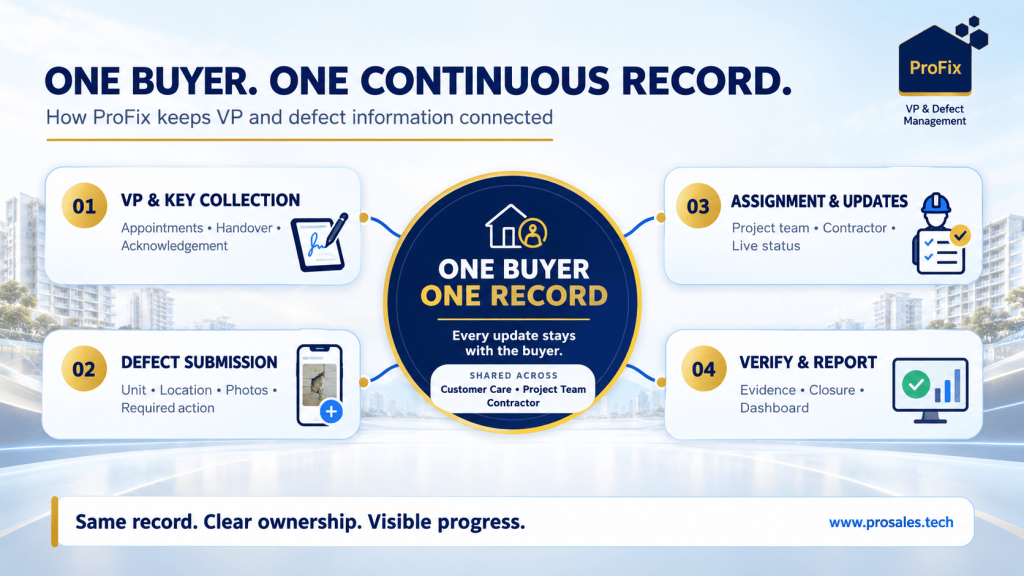
Perhaps the most expensive habit of all is structural. Many developers treat VP handover as a sales and operations milestone, and defect management as a completely separate customer service function, run by different teams, sometimes on entirely different tools. But these were never actually two processes. They’re one continuous relationship with the same buyer, and every disconnect between VP handover and defect resolution shows up to that buyer as inconsistency, being asked to repeat information they already gave, or discovering that the defect list from their key collection day never made it into the system the defect team actually uses.
What actually fixes this: Whatever tools are currently in use, make sure the same buyer record travels from key collection through to DLP closure, rather than starting a fresh file every time the unit moves to a new team. This is the core discipline behind genuine VP & defect management: one buyer, one continuous record, no matter how many internal teams touch it along the way. A proper VP management system Malaysia developers can rely on does this automatically, but the underlying principle holds even without software.
The Takeaway
None of these four habits look catastrophic individually. That’s exactly why they’re dangerous, and exactly why each one has a fix that doesn’t require a complete operational overhaul to start. A standardized key collection protocol, one intake channel with mandatory status updates, a named owner for every open DLP claim, and one continuous buyer record from handover to closure, these four changes alone close most of the gap most developers are quietly leaking reputation through.
Doing all four manually is possible with enough discipline. Doing them consistently, across every unit, every project, and every year of a DLP window, is where most manual processes eventually slip. This is precisely what a proper DLP defect management system, built into a genuine VP management system Malaysia developers can trust, is designed to hold together automatically, so the fix isn’t dependent on nobody ever forgetting.
See how ProFix keeps VP handover, defect management, and DLP tracking connected from day one, so none of these four habits have room to creep back in. Book a free demo today.