
Property developers across Malaysia are investing more than ever in generating leads, running paid campaigns, hosting showcases, and building out digital marketing funnels to bring buyers in. Yet for many developers, a property lead management system is the one piece of the puzzle still missing behind the scenes, and it’s quietly undoing all that upfront investment. Marketing brings the buyer to the door, but what happens after that first conversation is often left to chance, tracked in someone’s phone, a spreadsheet, or simply memory.
Property lead management is where most Malaysian developers quietly lose the most money, not through bad marketing or weak pricing, but through leads that simply fall through the cracks after the first conversation. A buyer messages an agent, gets a warm reply, and then… nothing. No second follow-up, no record of what was promised, no visibility for management until the buyer has already booked with a competitor. If any of this sounds familiar, you’re not alone, it’s one of the most common but least talked-about problems in property sales today.

The Silent Pain Points Costing Property Developers Sales
Before jumping to fixes, it’s worth sitting with what’s actually happening on the ground, because most developers underestimate how much revenue leaks through these gaps:
- Leads live in someone’s phone, not in a system. Without a proper property lead management system, a hot lead is only as safe as the agent’s memory and their willingness to log it somewhere.
- Follow-up depends entirely on individual discipline. There’s no automated follow-up for property sales, so if an agent is busy, on leave, or simply forgets, the lead goes cold without anyone noticing.
- Every project team tracks leads differently. One team uses an Excel sheet, another uses WhatsApp broadcast lists, and a third keeps notes in a physical notebook, so leadership can never get a clean, comparable view across projects.
- Hot leads and cold leads get treated the same. A buyer ready to book a unit today waits in the same queue as someone who asked a casual question three weeks ago.
- Management only finds out about lost deals after the fact. By the time a director asks “what happened to that lead?”, the buyer has usually already signed with someone else.
None of this is because agents don’t care. It’s because most developers are still running property sales without a real property sales management system behind them, just good intentions and a lot of manual effort.
Why Malaysian Property Developers Struggle Without a Dedicated CRM
This problem is especially common among property developer CRM Malaysia searches, because many local developers, even established ones, still run sales operations off a mix of Excel, WhatsApp, and personal memory. It’s not that the tools are bad individually; it’s that none of them were built to manage a property sales pipeline, and none of them talk to each other.
A generic spreadsheet can’t tell you which lead hasn’t been contacted in five days. A WhatsApp chat can’t automatically flag a buyer who just asked about pricing for the third time. And without a dedicated property developer CRM Malaysia teams can rely on, every project launch starts the same cycle over again: excitement, a flood of leads, and then a slow leak of buyers who simply never hear back in time.
The Cost of Missing Automated Follow-Up for Property Sales
Follow-up timing is one of the biggest, most fixable leaks in property sales, and yet it’s almost always left to chance. Without automated follow-up for property sales, here’s what typically happens:
- A lead enquires about a unit and gets a fast first response.
- The agent gets busy with a walk-in, a site visit, or another lead.
- Three, five, seven days pass with no second touchpoint.
- The buyer either goes cold or books with a developer who followed up sooner.
This isn’t a motivation problem, it’s a structural one. Even the most dedicated agent cannot manually track follow-up timing across 40, 80, or 150 active leads at once. The result is that developers keep spending on marketing to generate new leads, while a steady stream of already-interested buyers quietly slips away in the background.

How an AI CRM for Property Developers Solves These Blind Spots
This is where the shift from manual effort to a proper system changes the outcome. An AI CRM for property developers doesn’t just store lead information, it actively watches the pipeline. It flags leads that haven’t been contacted within a set window, standardizes reporting across every project and outlet, and gives management a single, real-time view of exactly where every lead stands, without needing agents to manually compile reports.
According to HubSpot’s State of Sales research, businesses that adopt centralized CRM systems with automated tracking consistently report faster lead response times and measurably higher close rates than those relying on manual, spreadsheet-based tracking, a gap that compounds significantly over multiple project launches.
The Role of an AI Sales Assistant for Property Developers
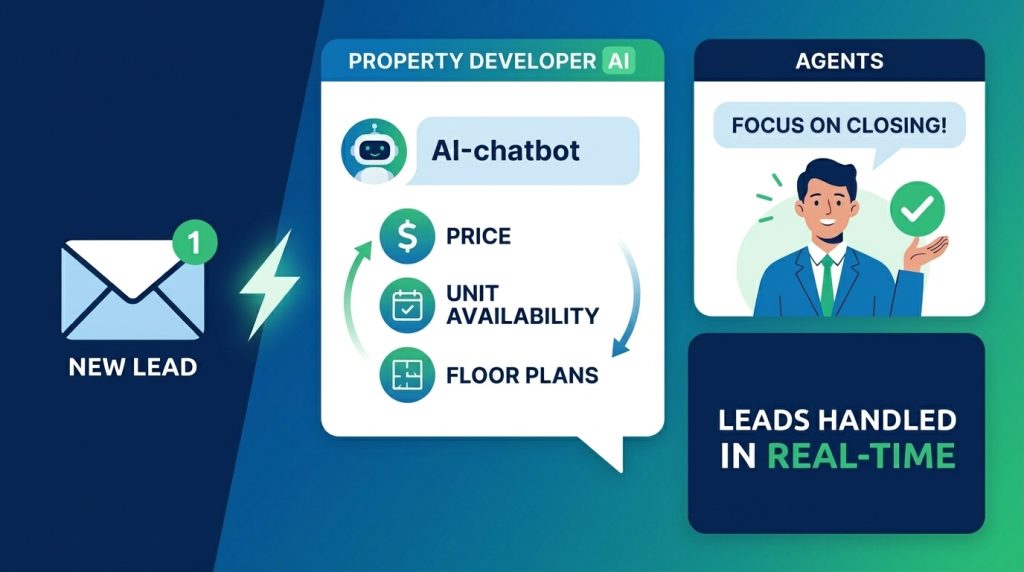
Beyond visibility, the next layer of the fix is response speed. An AI sales assistant for property developers can engage a new enquiry within seconds, answer common questions about pricing, unit availability, or floor plans, and automatically schedule the follow-up sequence, so no lead waits hours (or days) simply because every agent happened to be busy at that exact moment.
Crucially, this doesn’t replace the agent’s role in closing the sale. It removes the part of the job that was never really a good use of a salesperson’s time in the first place: chasing timing, remembering who to message next, and manually re-entering the same information into three different places.
Building a Property Sales Booking System That Actually Works
The developers who solve this problem for good aren’t necessarily buying more advertising or hiring more agents, they’re investing in a property sales management approach that closes the gap between “a lead came in” and “a lead was properly followed up and tracked.” This shift usually starts with recognizing that automated follow-up for property sales isn’t a nice-to-have anymore, it’s the difference between a buyer who feels attended to and one who quietly moves on to a competitor because nobody reached out in time. When follow-up timing is handled automatically instead of relying on an individual agent’s memory, no interested buyer is left waiting simply because the team got busy that week.
This is exactly the gap a proper property developer CRM Malaysia business can rely on is designed to close. Rather than every project team tracking leads in its own way, whether that’s a spreadsheet, a WhatsApp chat, or a notebook by the front desk, a dedicated CRM gives every team the same structure to work from, and gives management a single, comparable view across every project and location.
The next layer comes from intelligence, not just structure. An AI CRM for property developers doesn’t only store lead information, it actively watches the pipeline, flags leads that haven’t been contacted within a set window, and helps prioritize the buyers who are showing the strongest intent to purchase. Paired with an AI sales assistant for property developers, new enquiries can be engaged within seconds of coming in, answering common questions about pricing, availability, or floor plans, and automatically triggering the right follow-up sequence so no lead sits untouched simply because every agent happened to be occupied at that exact moment.
A system like ProSales brings lead capture, automated follow-up, and management-level visibility into one place, paired with a structured property booking system so every stage, from first enquiry to signed booking, is tracked consistently across every outlet and project.
See how Infra Mobile Digital’s AI-powered solutions bring your departments, franchises, and clients onto one unified system — book a free consultation today.