
If you’ve ever run a property launch, you already know the feeling. Everything looks fine on the surface, agents are busy, phones are ringing, forms are being filled out, but underneath it, something keeps slipping through the cracks. A property sales booking system Malaysia developers can actually rely on is supposed to catch those small failures before they turn into lost sales. Instead, most teams are still patching things together with paper forms, group chats, and a lot of goodwill from staff who are doing their best with tools that were never really built for the job.

None of this is anyone’s fault, exactly. In a fast-moving property industry, teams grow faster than their systems do, and by the time anyone notices the cracks, buyers have already walked away and booked somewhere else. Below are six of the most common pain points property developers run into during sales and booking, told the way they actually happen on the ground, along with what genuinely fixes each one.
1. Manual, Paper-Heavy Booking Forms
Walk into most sales galleries and you’ll still find stacks of physical booking forms, printed floor plans, and paper receipts, without a proper property sales booking system Malaysia developers can rely on, forms like this are the norm, not the exception. It works, until it doesn’t. During a busy launch weekend, forms get misplaced, someone’s handwriting is impossible to read, and reconciling paper records against the actual unit inventory at the end of the day turns into a stressful scramble. It’s also a little awkward when the same company is publicly talking about ESG digital transformation while its sales floor still runs entirely on paper.
The tricky part is that this doesn’t scale gracefully. One sales gallery can usually manage a stack of forms without too much trouble. But once a developer is running several launches at once across different projects or outlets, the paper trail grows just as fast as the sales volume does, and so does the risk that one lost or misfiled form quietly represents a lost sale nobody even notices until much later.
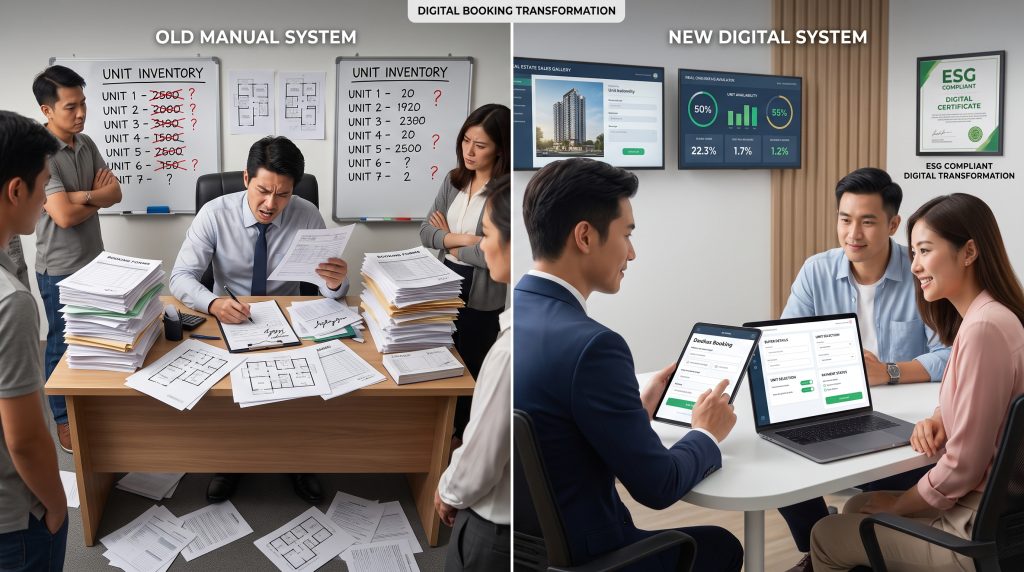
Suggestion: Digitize the booking form itself. A digital booking flow captures buyer details, unit selection, and payment status the moment they’re entered, cuts out transcription errors, and gives the developer a paperless audit trail that supports both day-to-day accuracy and genuine ESG digital transformation reporting at the same time.
2. No Real-Time Unit Availability
This is probably the most painful one on the list. Two agents, sometimes in two different parts of the same sales gallery, sometimes at two entirely different outlets, end up selling the same unit within minutes of each other, simply because neither of them could see that it had just been reserved. What follows is an awkward, trust-damaging conversation with one of the buyers, and every so often, a sale that’s lost for good.
Suggestion: A live, centralized inventory view solves this at the root. When every agent, no matter where they’re sitting, is looking at the exact same real-time unit status, double bookings stop being something staff have to remember to avoid. They simply become impossible.
3. Disconnected Sales Channels
Buyers reach out however is easiest for them, WhatsApp, phone calls, walk-ins, email, sometimes all four for the same person at different points in their decision. Without a shared system, the agent handling a walk-in has no way of knowing that the same buyer already asked about pricing over WhatsApp the week before. This isn’t a discipline problem. It’s simply what happens naturally in the absence of a proper AI-driven workplace tying all those channels together.
Suggestion: Bringing every touchpoint into one shared system, instead of expecting agents to manually cross-check five different apps, turns a fragmented AI-driven workplace into one where every agent has full context on every buyer, no matter which channel the conversation started in.
4. Slow, Manual Approval Chains
Booking confirmations usually need sign-off from a sales manager, sometimes finance, occasionally a director, especially for discounted units or unusual payment terms. When each of those approvals happens over email or a phone call, a booking that should take minutes can drag on for hours or even days. And in that window, a buyer who was ready to commit has plenty of time to have second thoughts, or simply book with a developer whose process moved faster.
Here’s the frustrating part. The delay rarely has anything to do with the approver being unwilling to help. More often than not, the request is just sitting unread in an inbox, or the approver is in back-to-back meetings and doesn’t see the message until much later in the day. From the buyer’s side, though, the reason for the delay doesn’t really matter. All they experience is a company that feels slow and disorganized at the exact moment they were ready to say yes.

Suggestion: Automated approval workflows with a connected property sales booking system, a core piece of most AI solutions for property developers, route bookings to the right approver instantly and flag anything that’s been sitting untouched for too long. This doesn’t take humans out of the decision. It just removes the delay caused by a request quietly going unnoticed.
5. No Centralized View of Sales Performance for Management
Ask a sales director how each project performed this month, and the honest answer is often, “let me check with each team and get back to you.” Without a single dashboard, comparing performance across multiple projects, outlets, or agents turns into a manual, time-consuming exercise, and by the time the numbers are finally compiled, they’re already out of date. According to HubSpot’s State of Sales report, sales teams using centralized, real-time dashboards report significantly faster decision-making than teams relying on manually compiled reports. This is exactly the gap that data-driven decision-making is meant to close.
Suggestion: A unified reporting dashboard, updated in real time, removes the need to manually chase updates from every team. That’s what data-driven decision-making actually looks like day to day, leadership seeing live numbers instead of a weekly summary stitched together from scattered spreadsheets.
6. Fragmented After-Sales and Documentation Tracking
Booking a unit is really just the start of the journey. From there, the Sale and Purchase Agreement, loan documentation, and buyer correspondence often end up scattered across separate systems, or worse, tucked away in individual staff members’ personal folders and inboxes. When a buyer calls to ask about their SPA status, staff often have to dig through several different sources just to give a straight answer, and that disorganization becomes even more obvious, and more damaging, once it’s happening across multiple projects at once.

Suggestion: An end-to-end property management solution Malaysia developers can use to track the full buyer journey, from the first enquiry through booking, SPA, and handover, in one continuous record removes this scramble completely. Staff can answer a buyer’s question in seconds because the information already lives in one place, not scattered across five.
7. Falling Behind as the Property Industry Digitizes
Finally, there’s a broader, quieter pain point: developers who delay modernizing their sales process aren’t just dealing with today’s inefficiencies, they’re falling behind competitors who have already adopted AI digital transformation and PropTech tools as standard practice. Buyers increasingly expect a smooth, fast, digital-first booking experience, and a developer still relying on manual processes risks looking outdated compared to competitors offering instant confirmations and transparent, real-time updates.
Suggestion: Rather than treating AI digital transformation as a distant, future project, developers can start with the sales and booking process specifically, the part of the business buyers interact with most directly and expand PropTech adoption from there once the team has seen the results firsthand.
All In One Hub Centre
None of these pain points really exist on their own. A paper-heavy booking process quietly feeds into poor documentation tracking, which then feeds into a management team that can never get a clean view of how things are actually going. The developers who solve this well don’t try to patch each problem with a separate tool. They invest in one connected system that removes the double entry, the manual chasing, and the constant guesswork across the entire sales and booking journey, from the very first enquiry all the way to the signed SPA.
See how ProSales brings real-time booking, automated approvals, and centralized reporting into one system. Book a free demo today.